By Khanyisa Dunjwa (Social Justice Activist, writing in my personal capacity)
“Equality feels like oppression when you are only accustomed to a life of privilege.”
This line stayed with me as I read about the 49 White Afrikaners who were granted refugee status in the United States. In a world where millions of refugees from war, hunger, and political collapse are stuck in limbo — often for years — it is telling that a group of white South Africans has managed to navigate a nearly frozen U.S. asylum system with relative ease.
These individuals are not stateless. They are not fleeing a war zone. They are not denied education, healthcare, or citizenship in South Africa. What they are fleeing is discomfort. Discomfort with a democratic society slowly and painfully beginning to address the deep racial and economic inequality rooted in our colonial and apartheid past. This is not a refugee story. It is a privilege story.
Helping refugees settle in any country is usually a lengthy and difficult process. It takes years. It involves exhaustive vetting, security screenings, interviews and is typically managed by the United Nations High Commissioner for Refugees (UNHCR) or its partners. But not for these 49. Their process took just three months. They were not vetted by the usual UN agencies. They were flown in on chartered planes — paid for by the U.S. government. That’s not just unusual. That’s privilege.
For centuries, Afrikaners in South Africa enjoyed absolute dominance — political, economic, cultural. Through apartheid, they benefitted from a system that violently displaced millions, excluded the Black majority from land ownership, and entrenched generational poverty. Even after 1994, many of those privileges persisted through wealth, land retention, and institutional access.
Now, as the country attempts land reform — including provisions for expropriation without compensation — and aims to rebalance an economy still skewed along racial lines, a familiar and dangerous narrative has emerged: the claim that white South Africans are under attack. That they are being “targeted” for their race. That they are victims. This narrative isn’t just false. It’s offensive. And it’s dangerous.
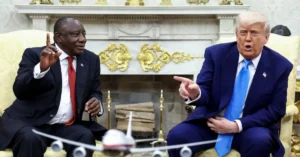
In 2018, former U.S. President Donald Trump amplified this myth when he tweeted that South African farmers were being killed “on a large scale,” suggesting the government was engaged in illegal land grabs. His comments echoed conspiracy theories of “white genocide,” giving legitimacy to a deeply racist and factually incorrect view of South Africa. The farm attacks are not racially motivated campaigns of extermination. Black farmworkers are also victims. Crime in South Africa is broad-based and driven by poverty, inequality, and unemployment, not racial hatred.
So why did these 49 Afrikaners succeed in their asylum claims? Why are they treated as refugees, while so many others are denied?
The answer lies in the global power of whiteness and the enduring sympathy it receives, even when the facts don’t add up. Whiteness — especially when paired with claims of victimhood — continues to open doors that are closed to the rest of the world. A Somali mother fleeing terror, a Congolese activist escaping death threats, or a Palestinian child born into statelessness would not be met with the same welcome. This is the double standard. This is global privilege in action.
Even in their claim of persecution, the Afrikaners remain privileged. Their whiteness continues to shield, to smooth over, to validate. They are still treated as the exceptional few who must be protee is acting on now reflects his long-standing perceptions of the country. Here’s the reality: there is no white genocide in South Africa.
Yes, we have violent crime. Yes, farmers — like many South Africans — are affected. Bucted, even as they leave behind a country where they still hold disproportionate land, capital, and generational power.
I am a black South African woman. I see and feel inequality every day — and it does not look like those who are leaving with foreign passports, overseas family networks, and safety nets most of us can only dream of.
What frustrates me is not that people seek safer lives abroad. That is their right. What frustrates me is the rewriting of history — and of the present — to paint a picture that is not true. The idea that white South Africans are being persecuted for their race, while the Black majority continues to face economic exclusion and landlessness, is both dishonest and dangerous.
South Africa is trying to fix what was broken long before any of us were born. Land reform is a legal, constitutional, and necessary process. It is not about hatred. It is about justice. And justice, by definition, cannot coexist with unearned privilege.
The United States must stop rewarding white discomfort with credibility. It must stop treating Afrikaner claims of persecution as fact while ignoring the lived experiences of millions of South Africans who remain poor, landless, and voiceless in their own country.
To those who’ve left, I say this: if you are truly persecuted, the world should protect you. But if you are simply uncomfortable with equality, please don’t call that oppression. And please don’t rewrite South Africa’s complex, painful journey in a way that makes you the hero of a story you helped write — but never fully acknowledged. We are not perfect. But we are trying. And that effort deserves honesty — not propaganda.