By Khanyisa Dunjwa (Social Justice Activist, writing in my personal capacity)
As a South African, watching Elon Musk’s ongoing political drama with Donald Trump unfold in real time feels strangely familiar. It’s not just a billionaire spat or an ego fuelled Twitter war. It’s a scene we recognise, a power play dressed in new clothes. Musk, our most famous tech export form Pretoria, appears to be engaging in a kind of influence game that carries echoes of the Gupta family’s notorious strategy here at home. But where the Guptas moved methodically, Musk seems to have rushed in headfirst.
The Musk-Trump saga is still unfolding. Just days ago, tensions between the two exploded into the public sphere. Trump took jabs at Musk, and Musk fired back, all playing out in front of millions online. This political spat is happening in real time, even as back-channel meetings continue. One can’t help but wonder: is this an orchestrated pressure campaign, with Trump acting as the catalyst and Musk as the beneficiary?
We’ve seen something like this before. When the Guptas rose to infamy, they did so not with tweets but with tenders. They didn’t pin their hopes on one politician. They understood that real influence requires patience and reach. They went beyond Jacob Zuma. They built networks across departments, state-owned enterprises, and party lines. They invested in the machinery of the state and extracted loyalty that paid off for years.
Musk’s approach, on the other hand, looks impulsive. By aligning himself closely with Trump and populating his social media platform, X (formerly Twitter), with right-wing voices, he gambled on proximity to power as a shortcut to influence. Its backfiring. Trump, ever the transactional operator, has turned on Musk, reportedly frustrated that the billionaire wouldn’t pledge absolute loyalty. For Musk, the lesson may be arriving too late, you don’t court long term political access through idolisation of leadership.
This brings us to the critical comparison. The Guptas captured the system. Musk tried to capture the moment. The Guptas operated through quite lobbying, strategic appointments and control of state procurement pipelines. Musk tried to disrupt politics like he disrupts industries – loudly, publicly and with flair. But the thing about power is, it doesn’t respond well to shortcuts.
If we are honest, this story is as much entertainment as it is insight. As South Africans, we recognise the patterns. There’s something almost comforting about seeing another country elites go through same missteps, the same shortcuts, and the same overreach we’ve lived through. It’s like watching a sequel where we already know the plot twists.
Of course, Musk is not the Guptas. He hasn’t yet reshaped the South African agenda, but his role in the U.S. government – particularly in the department overseeing critical funding decisions – has already had tangible impact, including cuts to USAID funding. This shows his influence is more than surface level. However, the instinct to bypass process through access, confuse attention for influence, and believe charisma can replace structure is very familiar. The Guptas mastered it in secret. Musk tests it in plain view. And that might be his biggest miscalculation. Power, especially in fragile democracies, prefers discretion over disruption.
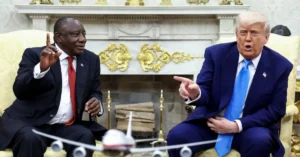
Now here’s where it gets interesting for us at home. There are quiet murmurings that Trump may have used his influence in a recent meeting with the South African government to nudge things along for Starlink’s entry into the local market. Coincidentally – or not – conversations around easing BBBEE regulations have surfaced again, seemingly to create space for companies like Musk’s to set up shop. The speculation is no longer abstract. On 23 May 2025, the South African government formally published a Gazette calling for public comment on proposed amendments to the BBBEE policy. These would allow companies like Starlink to meet empowerment targets through Equity Equivalent Investment Programmes (EEIPs) – a model that replaces direct ownership with infrastructure and skills investment. Minister Solly Malatsi has denied the policy is tailor – made for Starlink, but the timing raises eyebrows.
So, what happens now that Must and Trump are trading blows publicly? If Trump was indeed the political lubricant that helped grease the wheels for Musk in Pretoria, this very public falling our could complicate matters. The Starlink-friendly policy momentum may stall, especially if our policy makers begin to sense that the original diplomatic backing is eroding.
Would South African policymakers still push forward on relaxing regulations for a businessman now in a very public tiff with the same political backer who allegedly opened the door? Or would the process slow, stall, or be quietly shelved until the dust settle?
That’s the wild card. For now, the BBBEE easing talks remain just that – talks. But as always, where’s there’s smoke, there’s strategy. And if it turns out that foreign influence is shaping domestic policy through political intermediaries, we’d do well to look closer. The broader implications of this soap opera are still for Americans to grapple with. But from here, popcorn in hand, we can’t help but watch with a knowing smirk. We’ve seen how dangerous unchecked influence can be. We’ve paid for it. And now, we get to observe another would be master of the universe find out that power doesn’t bend just because you’re interesting on Twitter. So yes, we’re watching. And we’ve seen this movie before. We know how it ends. And this time, we’re just here for the show – but with one eye on what might come next.